
Instructions
Step 1: The Long Temper (Non-Negotiable)
-
Remove the roast from all packaging and pat it completely dry with paper towels.
-
Place it on a rack set over a baking sheet or tray, and leave it on the counter to temper. Minimum time: 4 hours for a 4–5 lb roast; add 1 hour for each additional pound. The roast should feel cool but not cold to the touch.
Step 2: Season & Pre-Heat
-
About 30 minutes before cooking, preheat your oven to 550°F (288°C). Ensure it is fully preheated—most digital ovens will indicate when ready.
-
Just before roasting, combine equal parts salt, pepper, and garlic powder. Massage the mixture aggressively over the entire surface of the roast, including the bones and sides.
-
Place the roast fat-side up in a shallow roasting pan. Do not add water. Do not cover.
Step 3: The High-Heat Blast
-
Immediately place the roast in the preheated oven. Close the door and do not open it again.
-
Cook for the exact time based on your desired doneness and the roast’s weight:
-
Rare (a cool, bright red center): 5 minutes per pound
-
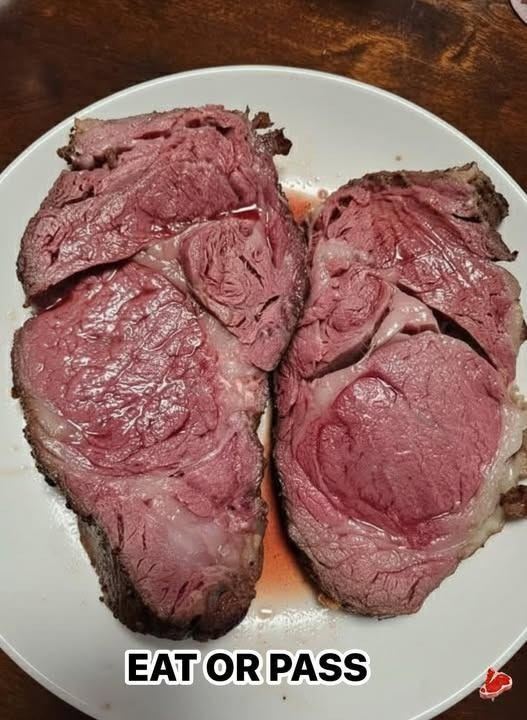
Medium-Rare (a warm, pink-red center): 6 minutes per pound
-
Medium (a warm, pink center): 7 minutes per pound
-
-
Example: A 5 lb roast for medium-rare = 5 x 6 = 30 minutes at 550°F.
Step 4: The Crucial Oven Rest
-
When the timer goes off, TURN THE OVEN OFF. DO NOT OPEN THE OVEN DOOR.
-
Leave the roast completely undisturbed in the closed, turned-off oven for 2 full hours. This is not a suggestion—it is the step that finishes the cooking gently and evenly from the outside in.
Step 5: Carve & Serve
-
After 2 hours, open the oven door. The internal temperature should be between 125–135°F (for medium-rare), perfect for slicing.
-
Transfer the roast to a carving board. Slice against the grain for boneless, or slice along the bones to release them before slicing the eye of the roast.
-
Serve immediately with pan juices, horseradish cream, and au jus.
The Science & Why It Works
This method utilizes the principle of carryover cooking. The initial high heat creates a flavorful crust (the Maillard reaction) while the oven’s residual heat continues to cook the interior gently and evenly during the two-hour rest. This eliminates the dreaded gray band of overdone meat, yielding a perfect gradient from edge to center.
Pro-Tips for Perfection
-
Weigh Accurately: Use a kitchen scale for precise timing.
-
Thermometer Check: If you’re anxious, verify the internal temperature after the 2-hour rest. It should read 125–135°F for medium-rare.
-
For Older Ovens: If your oven is not well-insulated, add 1 minute per pound to the initial blast time.
-
Make It Your Own: Add fresh rosemary or thyme to the rub. For a next-level crust, spread a thin layer of mayonnaise or Dijon mustard over the roast before applying the dry rub.
-
Leftovers: Cold prime rib makes the world’s best sandwiches. Slice it thinly for a luxurious treat.
You now hold the key to a legendary holiday centerpiece or special-occasion meal. Confidence is your best ingredient—enjoy the masterpiece you’ve created.
ADVERTISEMENT
